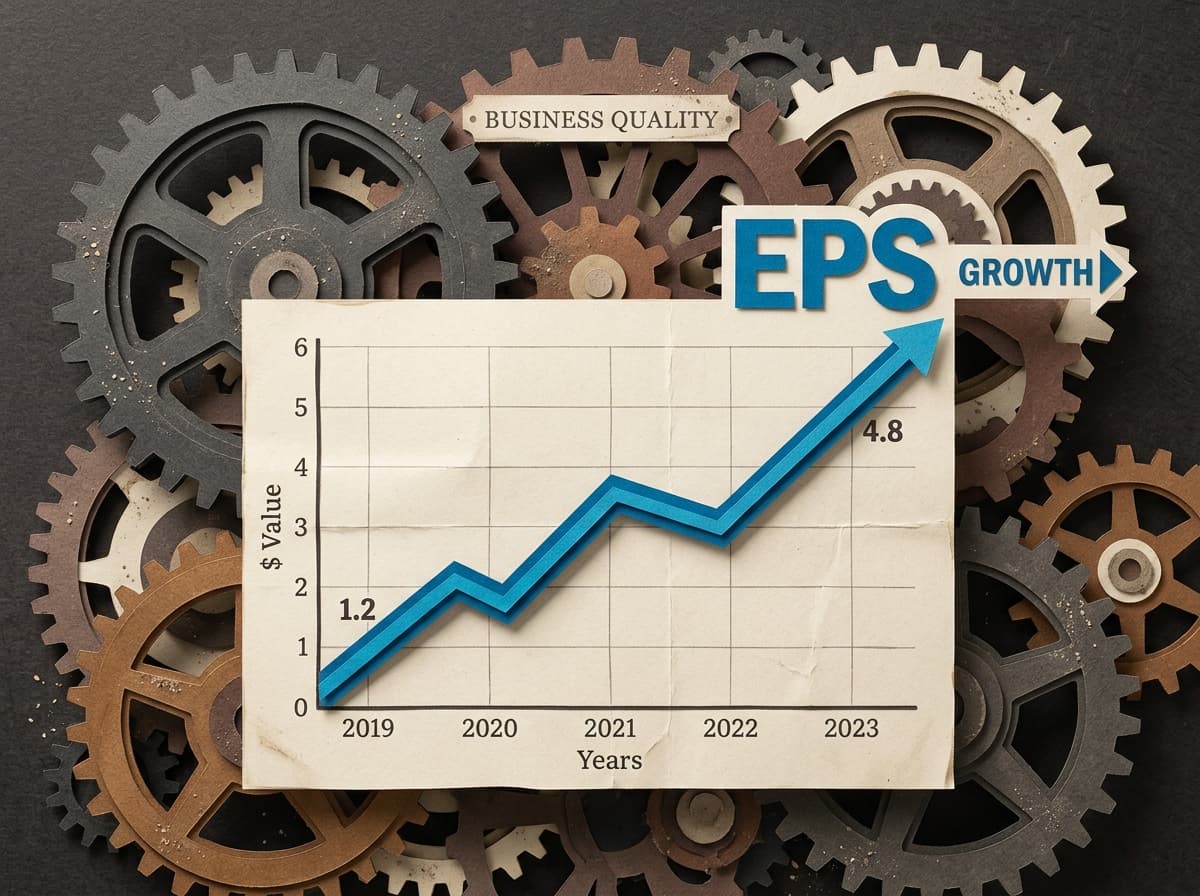
Earnings per share divides profit by the number of shares, so it can rise from either a bigger profit or a smaller share count. Buybacks that shrink the share count, one-off gains, accounting changes, and a lower tax charge can all lift EPS without the underlying business getting any stronger. Reading EPS well means checking why it moved, not just that it rose.
Key takeaways
- EPS is profit divided by the share count, so it can rise even when total profit is flat or falling.
- Share buybacks reduce the share count, mechanically raising EPS without improving operations.
- One-off gains and accounting changes can lift the profit in the numerator without reflecting recurring performance.
- A lower tax charge raises net profit and EPS even when pre-tax operating profit has not grown.
- To judge quality, look at whether operating profit and cash flow rose, not just the EPS figure.
What is earnings per share, and why can it mislead?
Earnings per share, or EPS, is a company's net profit divided by the number of shares outstanding. It expresses profit on a per-share basis, which lets investors compare companies of different sizes and feeds directly into the P/E Ratio. Because it is a ratio, it has two moving parts: the profit on top and the share count on the bottom.
That structure is exactly why EPS can rise without the business improving. A larger numerator is not the only way the number can go up; a smaller denominator does the same thing. So a rising EPS answers "did the per-share figure increase" but not "did the company get better." Those are separate questions, and only the second one describes the underlying business.
How do buybacks raise EPS without improving the business?
In a share buyback, a company uses its cash to purchase and cancel some of its own shares. With fewer shares outstanding, the same profit is now divided among a smaller base, so EPS rises even if total profit has not changed at all. If profit stays at 1,000 crore rupees but the share count falls by 10 percent, EPS rises by roughly 11 percent purely from the arithmetic.
Buybacks can be a sensible use of cash, particularly when a company has surplus funds and few better investments. But the resulting EPS increase reflects a smaller share count, not stronger operations. It is worth checking whether EPS grew because the company earned more or because it shrank its share base, and whether that cash might have created more value reinvested or held.
Open any stock on Artha Terminal to see EPS alongside net profit, share count, margins, and cash flow, and trace where a change came from.
How do one-off items and accounting effects lift EPS?
Because EPS is built on net profit, anything that inflates profit for non-operating reasons flows straight into it. A one-time gain from selling an asset, a subsidiary, or an investment can lift the profit and therefore the EPS in a single period, even though it will not repeat. The business is no stronger; the accounts simply captured a windfall.
Accounting changes can do the same. A revised depreciation schedule, a different way of recognising revenue, or a reversal of an earlier provision can raise reported profit without any change in the cash the business generates. These effects are usually disclosed in the notes to the accounts, which is why the trend in operating profit and cash flow is a better guide to durable earning power than a single EPS figure. This connects to Why profit is not everything, since EPS inherits every quirk of the profit line above it.
Why can a lower tax charge flatter EPS?
EPS is based on profit after tax, so the tax charge directly affects it. If a company's effective tax rate falls, whether through a statutory rate cut, the use of accumulated tax credits, or income taxed at a lower rate, net profit rises even when pre-tax operating profit is flat. The extra earnings come from the tax line, not from the business selling more or operating more efficiently.
India saw a clear example when the corporate tax rate was reduced in 2019, lifting the reported post-tax profits and EPS of many companies in the following results without any change in their underlying operations. A lower tax charge is real money for shareholders, but it is a one-time reset rather than ongoing operational improvement, so it should be read as such.
How can you check whether an EPS rise is genuine?
Trace the increase back to its source. Compare the growth in EPS with the growth in total net profit: if EPS rose much faster, a shrinking share count from buybacks is likely at work. Check whether operating profit, before one-off items and tax effects, actually grew, and whether operating cash flow moved with it. Read the notes for exceptional gains, accounting changes, and shifts in the effective tax rate. Measures such as Return on Equity and the trend in Book Value per share help show whether the company is genuinely earning more on its capital.
On Artha Terminal, the stock page shows EPS alongside net profit, share count, margins, and cash flow, so you can see whether a rise came from the business or from the arithmetic. AskWarren can break down why a company's EPS moved, in plain language, without offering any recommendation. Reading it this way, rather than reacting to the headline, is the habit behind Metrics that matter long term.