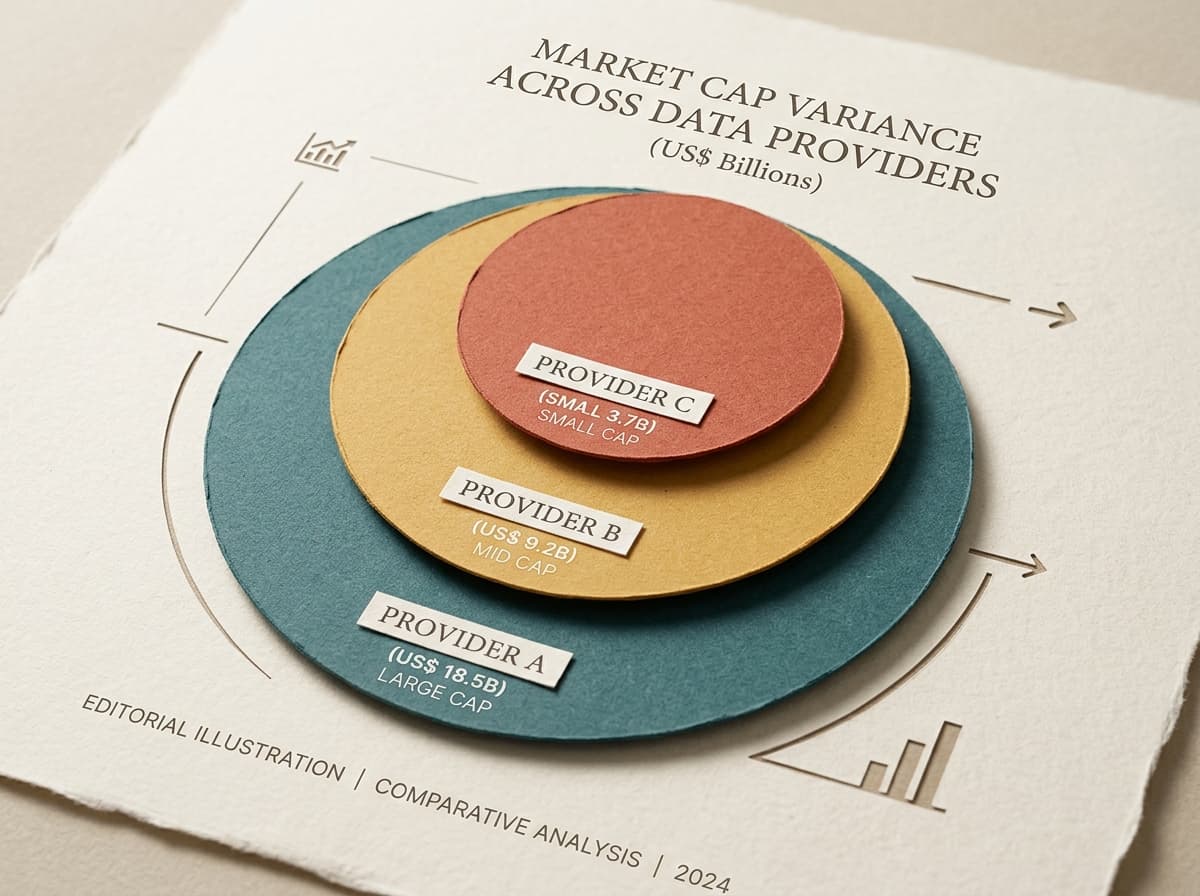
Market capitalisation is the share price multiplied by the number of shares, so websites disagree when they use a different share count or a price captured at a different moment. Some show total market cap using every share, while others show free-float market cap using only shares available to trade. Treasury shares, partly paid shares, and the timing of the last price all add small differences on top.
Key takeaways
- Market cap is share price multiplied by share count, so a difference comes from either the number of shares or the exact price used.
- Total market cap counts every share; free-float market cap counts only shares freely available to trade, and the two can differ a lot for promoter-heavy companies.
- Share counts update at different times across providers, so a recent issue, buyback, or conversion can be reflected on one site before another.
- Treasury shares, partly paid shares, and the precise moment a price was captured each shift the figure without anything changing at the company.
How is market cap calculated?
Market Cap is the share price multiplied by the number of shares a company has. Like the P/E Ratio, it has a price on one side and a share count on the other, and the price is read from the same exchange feed everywhere.
So when two websites show different market caps, the cause is almost always the share count they multiply by, or the exact instant at which they captured the price. Neither site is necessarily wrong; they are answering slightly different versions of the question "how many shares, valued when".
What is the difference between total and free-float market cap?
Total market cap uses every share the company has issued. Free-float market cap uses only the shares that are actually available for the public to trade, leaving out holdings that are locked away, such as promoter stakes, government holdings, and strategic investments.
For Indian companies this gap can be large, because many have high promoter ownership. A company where promoters hold 60 percent of shares has a free float of roughly 40 percent, so its free-float market cap is far smaller than its total market cap even at the same price. One website may headline the total figure and another the free-float figure, producing two very different numbers.
Free float is also what index providers use to weight companies in indices such as the Nifty 50. The mechanics of that calculation are covered in How free float is calculated.
Open any stock on Artha Terminal to see its market cap alongside the share count and price basis used to derive it.
Why do share counts update at different times?
A company's share count is not fixed. It rises when new shares are issued, through fresh equity, mergers, or the conversion of instruments into shares, and it falls when the company buys back and cancels shares.
Data providers refresh these counts on their own schedules. After a buyback completes or a large issue is listed, one website may update its share count within a day while another lags by a week or more. During that window the two report different market caps from the same price, simply because they are multiplying by different share totals.
This is the same reporting-lag problem that makes fundamental figures disagree, and it is one reason end-of-day and point-in-time data is treated as more dependable, as explained in Why EOD beats live data.
How do treasury and partly paid shares complicate the count?
Some share counts are genuinely ambiguous. Treasury shares, which a company holds in itself, for example through a trust, may or may not be included depending on the provider's convention.
Partly paid shares, where investors have paid only part of the face value and owe the rest, are another edge case. A provider may count them as full shares, as fractional shares reflecting the amount paid, or exclude them until they are fully paid. Each choice changes the total, and because these situations are uncommon, different sites resolve them differently without any error on either side.
Why does the timing of the price matter?
Even with an identical share count, the price side introduces small differences. One website may use the last traded price, another the previous day's official closing price, and a third a price that is a few minutes stale because of caching.
Multiplied across a large share count, even a small price gap becomes a visible difference in market cap. Around market open, close, and volatile sessions, these timing differences are at their widest.
On Artha Terminal, market cap is shown with the share basis it uses, and end-of-day figures are reconciled against exchange data so the number is stable and traceable rather than a moving target. You can open any stock to see both the value and the inputs behind it.