Max pain is the strike price at which the largest number of option buyers would lose money at expiry, calculated from the open interest currently sitting across all strikes. Because open interest is added and removed continuously as participants open and close positions, that strike moves, so the max pain level is recalculated and shifts from day to day. It is a snapshot of current positioning, not a target the price is drawn toward.
Key takeaways
- Max pain is the strike where option buyers, in aggregate, would lose the most value if the contract expired there.
- It is derived from live open interest across every strike, weighting each strike by the contracts open there.
- As participants open and close positions through the session, the open interest distribution changes, so max pain moves with it.
- Max pain describes where option value currently sits. It is not a prediction of where the price will settle.
What is max pain?
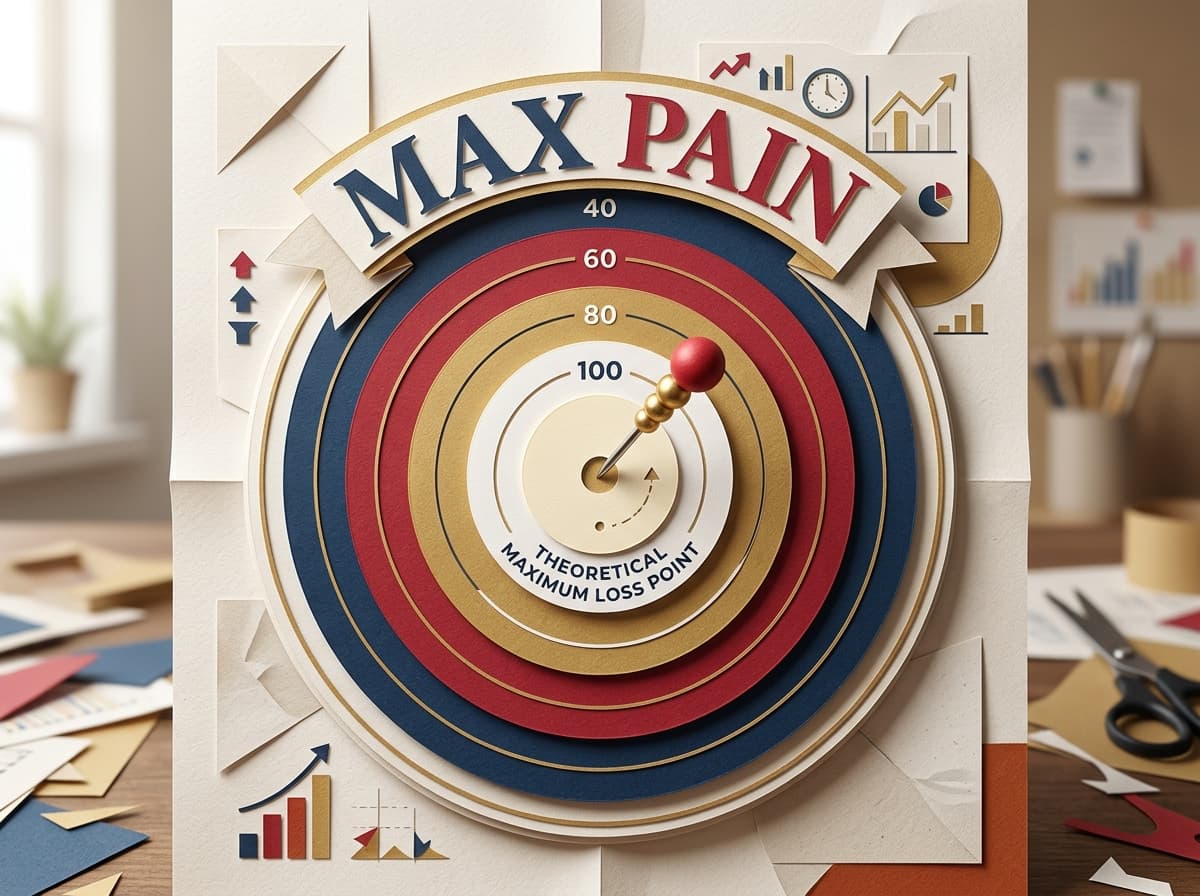
Max pain is the Strike Price at which the total value of options that would expire in the money, held by buyers, is at its lowest. Put differently, it is the price at which the greatest number of Call Option and Put Option buyers would see their contracts expire worthless, causing the maximum aggregate loss to option buyers and, correspondingly, the maximum retained Premium for the writers.
It is calculated by taking the Open Interest at every strike and working out, for each candidate settlement price, how much the outstanding options would be worth. The strike that produces the smallest total payout to buyers is the max pain point. It is an arithmetic result of the current positioning, nothing more.
Why is it derived from live open interest?
The calculation is only as current as the open interest it uses. Max pain weights each strike by how many contracts are open there, so the strikes with the heaviest Open Interest pull the result toward themselves. A single strike with very large call and put positions can anchor the number.
Because this depends entirely on where contracts are open right now, max pain is a live figure. Read at the market open it reflects yesterday's carried positions, and by the close it reflects everything that was opened and closed during the day. It is a photograph of positioning, and the photograph is retaken continuously.
View max pain computed from the end-of-day option chain, shown next to open interest by strike for index contracts on Artha Terminal.
Why does the level move from day to day?
Through a session, participants open new positions, close existing ones, and roll from one strike to another. Every one of those actions changes the open interest at the affected strikes, and since max pain is computed from that distribution, the calculated level shifts.
As an expiry approaches, positioning tends to concentrate and can move quickly, so the max pain strike can jump between sessions or even intraday. When a contract expires and attention moves to the next expiry, the open interest for that new series is different again, so max pain resets to a level set by the new distribution. The number is not fixed because the positioning it measures is not fixed.
Why is max pain not a price target?
A persistent myth is that price is somehow pulled toward max pain by expiry. The level is a description of where option value currently sits, derived purely from open interest. It carries no mechanism that forces the underlying to settle there, and prices frequently expire well away from it.
Max pain also changes precisely because participants react to price, so the causation, if any, runs in complicated directions rather than from max pain to price. Treat it as one lens on positioning among several, alongside the broader Open Interest pattern and the shape of the Derivative chain. It is information about the present, never a forecast of the close.
How can you follow max pain on Artha Terminal?
To use max pain sensibly you want to see the level next to the open interest distribution it comes from, and to watch how both move as expiry nears rather than reading a single static number.
On Artha Terminal, the derivatives section computes max pain from the live option chain for index contracts and shows it alongside the open interest by strike, so you can see why the level sits where it does and how it shifts session to session. You can ask AskWarren to explain, in plain language, what a change in the max pain level reflects about positioning. For the fuller picture of reading the chain, see Reading an option chain and Open interest and falling prices.